In heating, industrial circulating water systems, and other systems, the flow rate and head of the circulating water pump are key parameters that determine the system's operating efficiency. Correctly calculating these two parameters and selecting the right model directly affects energy consumption control, equipment lifespan, and system stability. The following starts from the actual working conditions to detail the logic of calculating the flow rate and head of the circulating water pump and key points for on-site application.
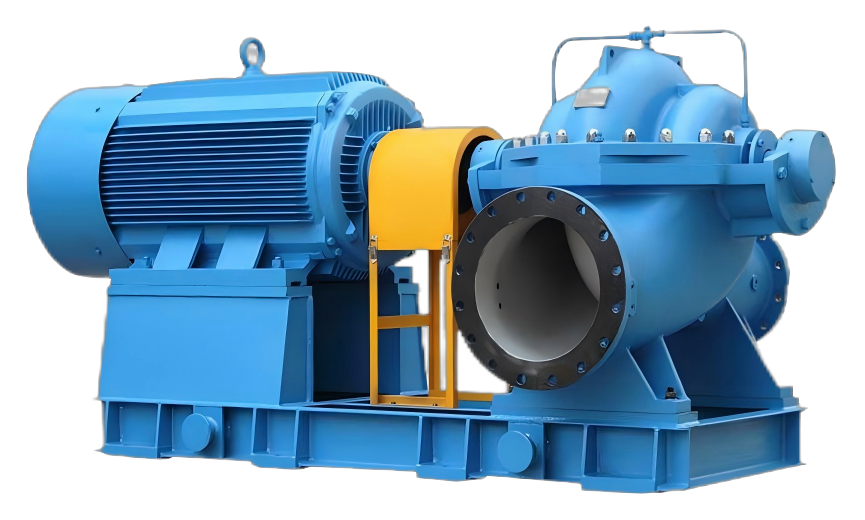
I. Flow Calculation: From Demand Overlay to Dynamic Adaptation
Determination of Total System Demand
The flow rate of the circulating water pump must meet the maximum demand of all thermal users. In a closed heating system, it is necessary to plot the flow rate change curves for each thermal load (such as heating, domestic hot water, etc.) and overlay them to obtain the system's peak flow rate. For example, when an industrial park has both process cooling and heating demands at the same time, the instantaneous maximum flow rates of both should be calculated separately and then summed up.
Dynamic Regulation Reserves
Actual operation must consider load fluctuations, usually with a margin of 10% to 15% added to the designed flow rate. If the system includes variable frequency control, it can be verified based on the minimum stable flow rate to avoid frequent start-up and shutdown of the pump during low loads.
II. Head Calculation: From Static Height to Dynamic Resistance
Basic Head Calculation
The head needs to overcome the vertical height difference of the system (such as the high difference between the boiler room and the user) and the total resistance of the pipeline. The formula is:
H = H_{\text{vertical}} + \sum H_{\text{local}} + \sum H_{\text{along}} + \Delta H_{\text{margin}}
Vertical Head ((H_{\text{vertical}})): Take the difference in height between the highest point of the system and the installation position of the water pump.
Pipeline Resistance: Includes elbows, valves (local resistance), and friction in straight pipe sections (along-line resistance), which need to be estimated through hydraulic calculation software or the Darcy formula.
Safety Margin: Usually increased by 5% to 10%, used to compensate for calculation errors or system aging.
Resistance Optimization Strategy
Pipe Diameter Selection: Increasing the pipe diameter can reduce the flow velocity, thereby reducing along-line losses (resistance is directly proportional to the square of the flow velocity).
Reduce the Number of Elbows: Using 45° elbows or slope connections instead of right-angle elbows can reduce local resistance coefficients by more than 30%.
III. Selection and Adjustment: Practical Application of Characteristic Curve
Characteristic Curve Matching
Mark the calculated flow rate (Q) and head (H) on the pump's characteristic curve:
Ideal Situation: The intersection point is located on the curve, directly select the corresponding model.
Insufficient Head (Intersection Point Above the Curve): If the difference is within 5%, adjust the pipeline to reduce resistance; if the difference is too large, select a pump with higher head or operate in series.
Excessive Head (Intersection Point Below the Curve): Consider cutting the impeller (the amount of cut needs to be verified according to the specific speed formula) or paralleling small pumps to share the flow.
Curve Type Selection
Flat Q-H Curve: Suitable for scenarios requiring stable head (such as constant pressure water supply).
Steep Dropping Q-H Curve: Suitable for flow-sensitive systems (such as oil transportation, where a sudden increase in head at low flow can erode pipeline scale buildup).
IV. Key Points for Field Application
System Matching Verification
After installation, it is necessary to measure the actual operating parameters using an ultrasonic flowmeter and a pressure sensor to verify the deviation between the actual value and the design value, and adjust the valve opening or frequency converter settings if necessary.
Dynamic Change Response
Seasonal systems (such as heating) require the configuration of a frequency converter or paralleling multiple pumps to adapt to load changes. For example, during winter peak hours, run at full speed, and switch to single pump low-frequency mode in transition seasons.
Special Medium Treatment
For high-temperature or corrosive liquids, it is necessary to select temperature-resistant seals (such as graphite packing) and stainless steel materials (304/316L). For example, when transporting hot water above 80°C, it is necessary to confirm the bearing cooling structure and material's heat resistance.
V. Reference Case Examples
In a heating station renovation project, the original pump had a head of 45m, but due to increased resistance caused by aging pipelines during actual operation, the head requirement was raised to 50m. By replacing the impeller (with a diameter cut by 5%) and optimizing the pipeline layout (reducing three right-angle bends), the system efficiency was improved by 12%, saving about 32,000 kWh per year.
The calculation of the flow rate and head of circulating water pumps requires a comprehensive consideration of static parameters and dynamic needs, and efficient operation is achieved through scientific selection and system optimization. In practical applications, it is recommended to combine hydraulic model simulation with actual measurement data for iterative correction, while also paying attention to the integration of intelligent control technologies (such as Internet of Things monitoring) to further improve system energy efficiency and reliability.









 WhatsApp
 E-mail